

Johannesburg vs Cape Town in July: Why South Africa's Two Biggest Cities Are in Different Seasons
The Johannesburg Cape Town Weather July Difference Is Bigger Than Most Travelers Expect
July sits squarely in the South African winter, but that single fact covers a surprising amount of climatic ground. Johannesburg in July is dry, sunny, and cold at night — highveld winter at its most straightforward. Cape Town in July is wet, overcast, and mild — a proper Mediterranean winter that has more in common with Lisbon in February than with anything happening 870 miles (1,400 km) to the northeast. Travelers who route through both cities in the same trip and pack one set of clothes for "South African winter" routinely get this wrong in both directions.
The numbers make the contrast concrete. Average daily highs in Johannesburg sit around 62°F (17°C), with overnight lows regularly dropping to 37–41°F (3–5°C). Cape Town's highs hover near 63°F (17°C) — almost identical — but lows rarely fall below 46°F (8°C). On paper, the cities look close. In practice, the humidity, rainfall, and sunshine hours make July feel entirely different on the ground.
Johannesburg in July: Altitude, Aridity, and Temperature Swings
Johannesburg sits at 5,750 feet (1,753 m) above sea level. That altitude is the most underreported factor in any Johannesburg weather discussion. At that elevation, the thin air holds less heat after sunset, which is why the city can hit 63°F (17°C) at noon and 37°F (3°C) by 3 AM. A 25°F (14°C) daily swing is not unusual. Travelers arriving from sea-level cities and dressed for the afternoon high will be badly underprepared by dinner.
July is also Johannesburg's driest month. Average rainfall is around 0.3 inches (8 mm) for the entire month — essentially negligible. The city sees roughly 8–9 hours of sunshine per day. The air is genuinely arid: relative humidity averages around 30–40% in the afternoons, which is low enough to cause cracked lips, dry eyes, and dehydration faster than most people expect. Travelers prone to altitude-related headaches should factor in both the elevation and the dryness; the combination accelerates dehydration.
The lack of rain also means the landscape looks it. Johannesburg's trees lose their leaves, the grass goes gold-brown, and the city takes on a spare, dusty quality that surprises visitors who associate sub-Saharan Africa with lush greenery. There is nothing wrong with this — it is simply what the highveld looks like in winter — but it catches people off guard.
UV index in Johannesburg in July typically runs 4–5 (moderate), elevated by the altitude even in winter. Sunscreen is not optional.
Cape Town in July: Rain, Wind, and the Atlantic's Full Attention
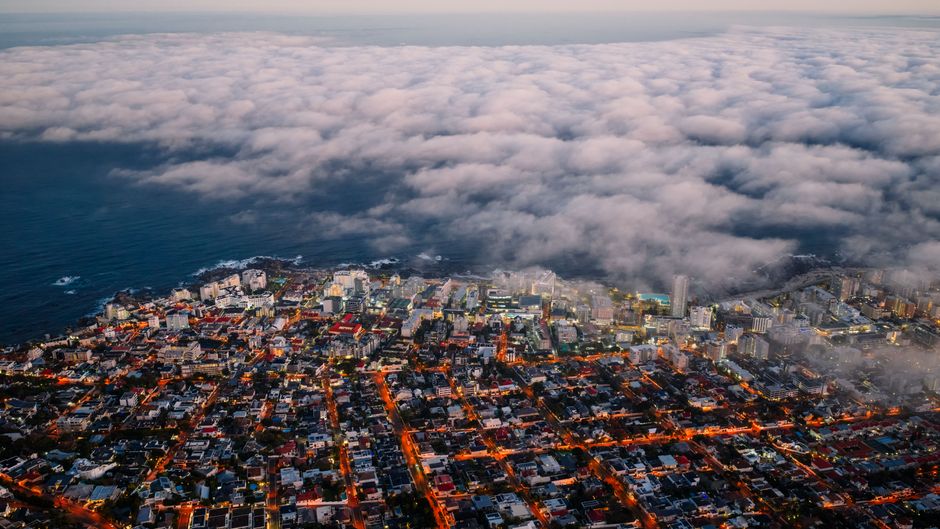
Cape Town's July weather is driven by the Cape's Mediterranean climate: dry summers, wet winters. July is the wettest month of the year, with average rainfall around 3.3 inches (85 mm) spread across roughly 17–18 rain days. That is not monsoon-level precipitation, but it is persistent. The Western Cape's winter systems come in off the South Atlantic as cold fronts, which means rain often arrives with wind — sometimes strong wind. The Cape Doctor (the famous southeaster) is less prevalent in winter, but north-westerly gales replace it, and they are not gentle.
Humidity sits around 75–80% in July, which makes the 63°F (17°C) high feel noticeably colder than the same temperature in dry Johannesburg. Damp, breezy 63°F (17°C) with cloud cover is a different experience than crisp, sunny 62°F (17°C) on the highveld. Pack accordingly.
Sunrise is around 7:50 AM, sunset around 5:50 PM — about 10 hours of daylight, some portion of which will be overcast. Table Mountain's cable car closes frequently in July due to low cloud and wind; this is not a "check the morning forecast and decide" situation, it is a multi-day planning problem. Hikers should build flexibility into their Cape Town itinerary because the mountain is routinely inaccessible for stretches of three to five days during active frontal systems.
The upside: Cape Town's tourist crowds are at their annual low in July. Hotels are cheaper, restaurant reservations are easier, and the Winelands are quiet. The tradeoffs are real, though — beach days are off the table, outdoor activities are weather-dependent, and driving the Cape Peninsula on a rainy, 45 mph (72 km/h) wind day is not particularly pleasant.
Side-by-Side: July Weather Data
- Average high: Johannesburg 62°F (17°C) | Cape Town 63°F (17°C)
- Average low: Johannesburg 37–41°F (3–5°C) | Cape Town 46–48°F (8–9°C)
- Monthly rainfall: Johannesburg ~0.3 in (8 mm) | Cape Town ~3.3 in (85 mm)
- Rain days per month: Johannesburg 1–2 | Cape Town 17–18
- Afternoon humidity: Johannesburg 30–40% | Cape Town 75–80%
- Daily sunshine hours: Johannesburg 8–9 hrs | Cape Town 4–5 hrs
- Altitude: Johannesburg 5,750 ft (1,753 m) | Cape Town ~50 ft (15 m) city center
The Packing Mistakes That Actually Happen
The most common error: packing a rain jacket for Cape Town and leaving it there when flying to Johannesburg, because "it's the dry season." Correct — but Johannesburg's overnight temperatures demand a proper insulating layer, and thin waterproofs without insulation leave travelers freezing at altitude after dark. The fix is a mid-layer (fleece or down) plus the rain shell, not one or the other.
The reverse mistake happens too. Travelers arriving in Cape Town from Johannesburg, primed for dry cold, bring heavy knits but no waterproofing. They stay reasonably warm but get soaked. Cape Town's rain is not dramatic — it is the steady, sideways, drizzle-plus-wind type that defeats umbrellas and saturates unprotected wool within twenty minutes.
A practical Cape Town note: waterproof footwear matters more than most guides admit. Puddles on the cobblestones of Bo-Kaap or the pavements around the V&A Waterfront are not a minor inconvenience when it rains for three days straight.
For real-time planning across both cities, the WeatherGO app shows hourly conditions and frontal timing — useful when you're deciding whether Cape Town's Table Mountain cable car will actually open tomorrow, or how cold Johannesburg's 6 AM departure will feel.
Practical Takeaways
- Do not use Cape Town's July highs to set expectations for how cold Johannesburg nights get. The overnight gap between the two cities is roughly 10°F (5–6°C), which is significant when one of them is below 40°F (4°C).
- Johannesburg: pack insulating mid-layer, sunscreen (UV index still moderate at altitude), lip balm, and a reusable water bottle. Rain gear is largely unnecessary but takes almost no space.
- Cape Town: waterproof outer layer, waterproof footwear, and realistic expectations about outdoor activity. Build 2–3 flexible days into any itinerary that relies on Table Mountain or the Peninsula.
- Altitude acclimatization in Johannesburg is mild compared to, say, the Andes — but combine it with low humidity and you will feel more dehydrated faster than at sea level. Drink more water than seems necessary.
- The temperature highs in both cities are nearly identical. Stop there and the comparison misleads. The full picture — humidity, rainfall, sunshine, and altitude — tells a genuinely different story for each city.


