

Santorini in Late July: How the Meltemi Wind Changes Everything About Swimming, Sailing, and Sun Exposure
Santorini Wind in July: What the Meltemi Actually Does to Your Trip
Late July in Santorini means one thing above all else: the Meltemi is running. This northerly wind system dominates the Aegean from mid-June through August, and by late July it is blowing sustained speeds of 40–60 km/h (25–37 mph) across the caldera with gusts that regularly exceed that. Temperatures sit around 28–32°C (82–90°F) in the shade, the sky is a relentless cloudless blue, and the UV index peaks at 10–11 — firmly in the "extreme" category. The wind makes it feel cooler than it is, which is one reason visitors underestimate sun exposure badly. Understanding the Santorini wind in July, and specifically how the Meltemi behaves, is not optional information. It is the difference between a usable beach day and a miserable one spent watching your umbrella cartwheel into the sea.
The Meltemi: Where It Comes From and Why It Intensifies in Late July
The Meltemi is a katabatic pressure gradient wind generated by the thermal low that develops over the heated landmass of Asia Minor through summer. As that low deepens, it pulls cool, dry air southward from the Balkans across the Aegean. The pressure gradient tightens through July, which is why the Meltemi gets progressively stronger as the month goes on — it is not a storm system that passes. It is a structural feature of Aegean summer meteorology that runs for days or weeks at a stretch.
In Santorini's case, the island's orientation amplifies the effect. The caldera sits on the western side, partially shielded by the island's volcanic rim. The northern and eastern coasts face directly into the prevailing northerly flow. On the Meltemi's strongest days — and late July will produce several — the wind arrives from the NNW to NE quadrant at sustained 50–60 km/h (31–37 mph), with gusts that push past 70 km/h (43 mph). Wind-chill effect at those speeds in 30°C (86°F) heat can make ambient temperature feel closer to 22–24°C (72–75°F), which is comfortable enough to stay in the sun for two hours without noticing you are burning at UV 11.
Which Beaches Are Unswimmable — and Which Are Not
The Meltemi's northerly direction creates a clear split across Santorini's coastline. North and east-facing beaches take the full force. South and southwest-facing beaches are sheltered behind the island's mass and generally remain swimmable even on high-wind days.
Beaches to Avoid on Meltemi Days
- Monolithos Beach — Flat, exposed, east-facing. Waves build quickly on northerly winds. Umbrellas do not stay upright. The beach is essentially unusable above 35 km/h (22 mph).
- Kamari Beach — Popular, east-facing black sand. The wind funnels down the hillside above it. Choppy surf, airborne sand, and beach furniture that migrates on its own. Sun lounger operators there will tell you it is "a bit windy." It will be worse than that.
- Perissa Beach — Also east-facing, same issues as Kamari. The long stretch of black volcanic sand becomes an effective sandblasting corridor in strong Meltemi conditions.
Beaches That Stay Sheltered
- Vlychada Beach — South-facing, backed by dramatic white pumice cliffs that break the wind considerably. Swimmable on most Meltemi days. Water can still be choppy but is manageable.
- Agios Georgios Beach — Southwest orientation, reasonable shelter. A reliable fallback when the north is blown out.
- Red Beach (Kokkini Paralia) — West-facing and partially enclosed by the volcanic cliffs, though access requires care and the cliffs themselves have rockfall risks that are unrelated to wind. Calmer water than the east coast on northerly days.
- Caldera-side swimming spots (Ammoudi Bay, Thirassia) — The caldera is shielded from the Meltemi's worst effects. Ammoudi Bay sits directly below Oia and remains calm on most days. It is also where some of the clearest water in the island is found.
Sailing and Boat Trips: What the Meltemi Does to Your Excursion
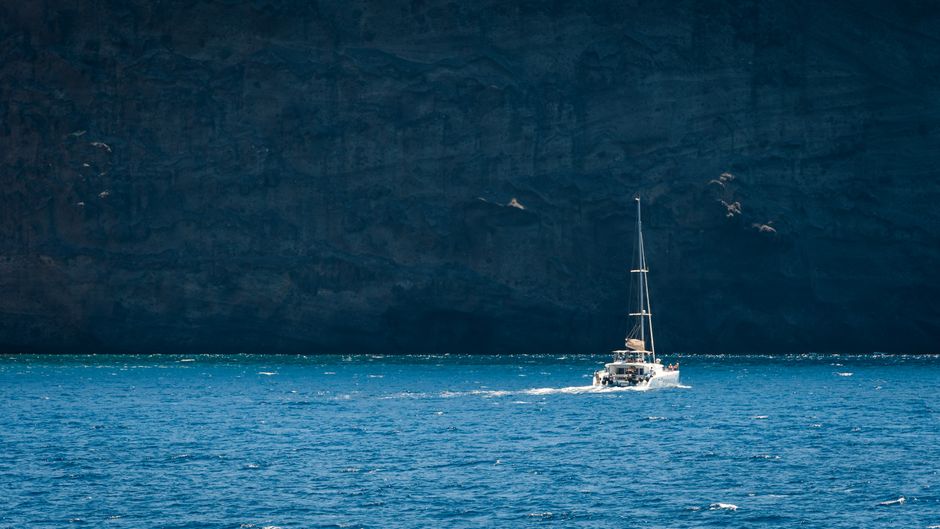
The short version: many sailing excursions in late July operate on a modified or cancelled basis on peak Meltemi days, and operators will not always tell you this upfront at the time of booking.
The standard catamaran or sailing boat day trip around the caldera — volcano stop, hot springs, sunset watch — is viable in winds up to around 35–40 km/h (22–25 mph). Above that, the crossing to the volcano island (Nea Kameni) becomes rough and the hot springs stop is typically skipped because small tenders cannot operate safely. Crossings to Thirassia from the caldera are usually fine since that route runs somewhat sheltered from the main northerly flow.
If sailing independently or chartering, the southern route down to Vlychada and around Cape Exomytis is more manageable in strong Meltemi conditions than trying to work north toward Oia. The northern caldera rim gets significant chop where the wind accelerates around the headland above Oia. Routes that keep the island's mass between the boat and the northerly wind are obviously preferable.
Check the forecast the evening before any boat trip. The WeatherGO app gives hourly wind speed and direction data for Santorini that is specific enough to tell you whether tomorrow's excursion is going to be a pleasant sail or a wet, windy slog across a 2-meter (6.5-foot) chop.
UV Exposure: The Meltemi's Deceptive Side
This is where the Meltemi genuinely catches people out. A steady 45 km/h (28 mph) breeze in 30°C (86°F) heat feels pleasant. It does not feel like a situation requiring serious sun protection management. It is. Late July UV index values in Santorini run between 10 and 11 between approximately 10:00 and 15:00 local time (EEST, UTC+3). Sunrise is around 06:20, sunset around 20:45, with UV becoming significant — above index 6 — from roughly 09:00 through 18:00.
At UV index 11, unprotected fair skin can begin to burn in as little as 10–15 minutes. The Meltemi's cooling effect means most people stay in full sun longer than they would on a still, oppressively hot day when discomfort drives them into the shade. The wind also dries sweat and sweat-mixed sunscreen faster than most people account for, which degrades SPF protection on skin surfaces. Reapplication every 60–90 minutes is not excessive for late July Santorini — it is appropriate.
Additional notes on UV in this context:
- Volcanic black sand beaches (Kamari, Perissa) absorb and radiate significant heat and UV. UV exposure at these beaches is meaningfully higher than on white sand or rocky surfaces due to reflected radiation from the dark sand.
- Water reflection adds further UV load. Caldera swimming spots and boat trips carry a double UV burden — direct and reflected.
- The peak UV window aligns almost exactly with peak Meltemi strength. Morning and late afternoon, when UV is lower, are typically also calmer wind periods.
Practical Takeaways for Late July
- Build itineraries around the wind direction, not just the calendar. Check forecasts 12–24 hours ahead and assign beach days to sheltered coasts when the Meltemi is running hard.
- Book sailing excursions with cancellation flexibility. Operators who will not refund on wind-cancelled trips are common. Read the terms before booking.
- SPF 50+ is the floor, not the ceiling. Reapply every 90 minutes. The wind is not protecting you from the sun — it is hiding how exposed you are.
- Seek shade between 11:00 and 15:00 on UV-extreme days. This is not overly cautious. This is calibrated to actual UV index 10–11 conditions.
- Pack a windproof layer for evenings. Oia at sunset with a 50 km/h (31 mph) wind blowing off the caldera drops to feels-like temperatures of 18–20°C (64–68°F). The Instagram crowd dressed for summer will be cold. Plan accordingly.
- Kamari and Perissa are worth visiting for their character but schedule those visits for calm mornings, not peak wind afternoons.


